

The man’s journey into the industrial wasteland of his mind. Or an allegory of life itself. Where, to get to your desire, you cannot take a straight path.
In the process there is a debate inside your mind about the utilitarianism and the love of abstract. Science vs. Art. What helps humanity more. Or how humanity helps whatever there is to help — more.
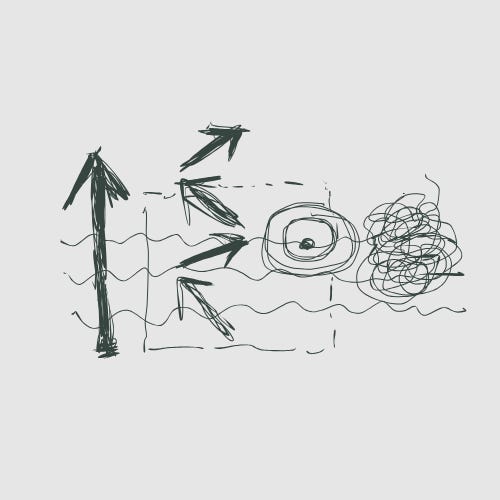
.Or an escape from the reality — which really is not a reality. Because what is reality but abstract rules — symbols, some written, some understood, and some hidden — created by humanity to keep us tied up — into what I don’t know but tied up for sure.
The journey is more important. before I got to the release of the tension — if there is any, at which point the tension disappears and all is lost.
It’s like an odyssey — a rite of passage — letting go — letting go of prejudice, fear, preconceived notion, uncertainty
Be soft pliable not hard and strong
The guide might be completely deranged, only all leaders are deranged and by following such deranged minds humanity makes a leap
You dream of something and get something very different
Why the light — what about the telephone
A dog in the corner with a skeleton hand, a weed, and an empty bottle
Was that his wife?
All this poetry and walking around is a new, original way of apologizing. But I understand you. A difficult childhood. But don’t fool yourself. I don’t forgive you.
The crown of thorn — I get the allegory.
The desire that you have suffered the most for.
When a man thinks of the past he becomes kinder
The main thing is, you must believe
Happiness, freedom, dignity
They have taken everything from me behind the barbed wire
Conscience and soul searching were all created by the mind
Essence of man’s true nature — that is such man’s imagination — so certain (or looking for something so certain)
Intelligentsia — capacity of faith depleted
They’re thinking how to not sell themselves cheap, how to get paid for every breath that they take
—
What if the thing a person most deeply desires is not the thing they consciously think they desire?
The Room doesn’t simply grant wishes. It exposes something underneath the stated wish. That’s why the Stalker is so terrified of it. The story about Porcupine is a warning: he entered believing he wanted one thing, and the Room answered the desire he didn’t consciously acknowledge.
What if suffering for something doesn’t prove that you truly want it? What if your conscious self can spend years constructing an elaborate identity around a goal your deeper self doesn’t actually share?
Notice how absurdly difficult Tarkovsky makes the journey. The characters walk, talk, stop, change direction, lie down, argue, wait — and geographically accomplish almost nothing. The journey strips away the ordinary world. Letting go of prejudice, fear, preconceived notion, uncertainty — and letting go of the idea that you know yourself. The closer they get to the Room, the less confident they become about what they actually want. The ending doesn’t need a conventional revelation. The uncertainty is the revelation.
The Professor wants to understand, measure, explain, control. The Writer wants to create meaning from it. The Stalker wants to believe. Science can become destructive because it wants to master things. Art can become narcissistic because the artist wants to turn everything into material. Faith can become dangerous because believing doesn’t necessarily mean believing in something true. These highly educated people have knowledge. Knowledge hasn’t given them meaning.
The Stalker: a prophet, a fool, a religious pilgrim, a cult leader, a broken man, an addict — or someone who invented meaning where none exists. Tarkovsky keeps all of it alive.
He isn’t merely a guide taking tourists somewhere. He suffers for other people’s salvation — repeatedly bringing people to the Zone because he believes they need it, without receiving what he’s seeking himself. Not simply Stalker as Christ. Closer to someone who has made faith itself his life’s purpose, without being capable of receiving the thing he’s guiding others toward.
The ordinary world imprisons you with — laws prisons money professions social status intellectual pretension political structures industrialization barbed wire
The Zone is forbidden because it offers freedom from that. And yet inside it, they become more constrained. Can’t walk straight. Can’t trust the path. Can’t simply take what they want. Have to surrender control.
The world outside imprisons you by rules. The Zone frees you by giving you rules you cannot understand.
Ordinary life assumes A → B → C. You walk toward something and reach it. In the Zone: A → maybe B → no, turn around → something happened → you don’t understand why. A world where human rationality stops being sufficient. The Zone as a physical manifestation of consciousness itself.
Don’t rush to decode the dog, the skeleton hand, the bottle, the weeds as one-to-one symbols. Tarkovsky resists the idea that every object needs a dictionary definition. The dog feels more like a presence than a symbol. The skeleton hand — almost comically blunt as an image of death. The bottle is mundane. The weeds are alive. The dog is alive. Human civilization, death, decay, nature — indifferent to category.
Was that his wife — yes. Pay attention to her. She’s central to what the Stalker has sacrificed for his faith.
Don’t look up a definitive explanation of the ending. There’s something in not knowing yet that you’ll lose the moment you read too much too soon: your own uncertainty.
The movie’s central question, maybe:
If you were given the absolute power to fulfill your deepest desire, would you actually want to know what that desire is?
And maybe even more frightening —
What if your deepest desire belongs to a version of yourself you don’t recognize?
—>Me feeling it runtime, AI analyzing it post-facto